Every asset class that matters began the same way: as a large, obviously valuable pool of cash flows that nobody could price consistently enough to trade. Mortgages were once idiosyncratic paper held to maturity by the bank that wrote them. Auto loans were a lender's problem, not an investor's opportunity. What changed, in each case, was not the underlying cash flow. What changed was that someone found a way to standardize the risk — to make heterogeneous obligations legible enough that capital markets could underwrite them at scale.
Healthcare receivables sit in exactly that pre-securitization moment, and the pool is large.
The Size of the Opportunity
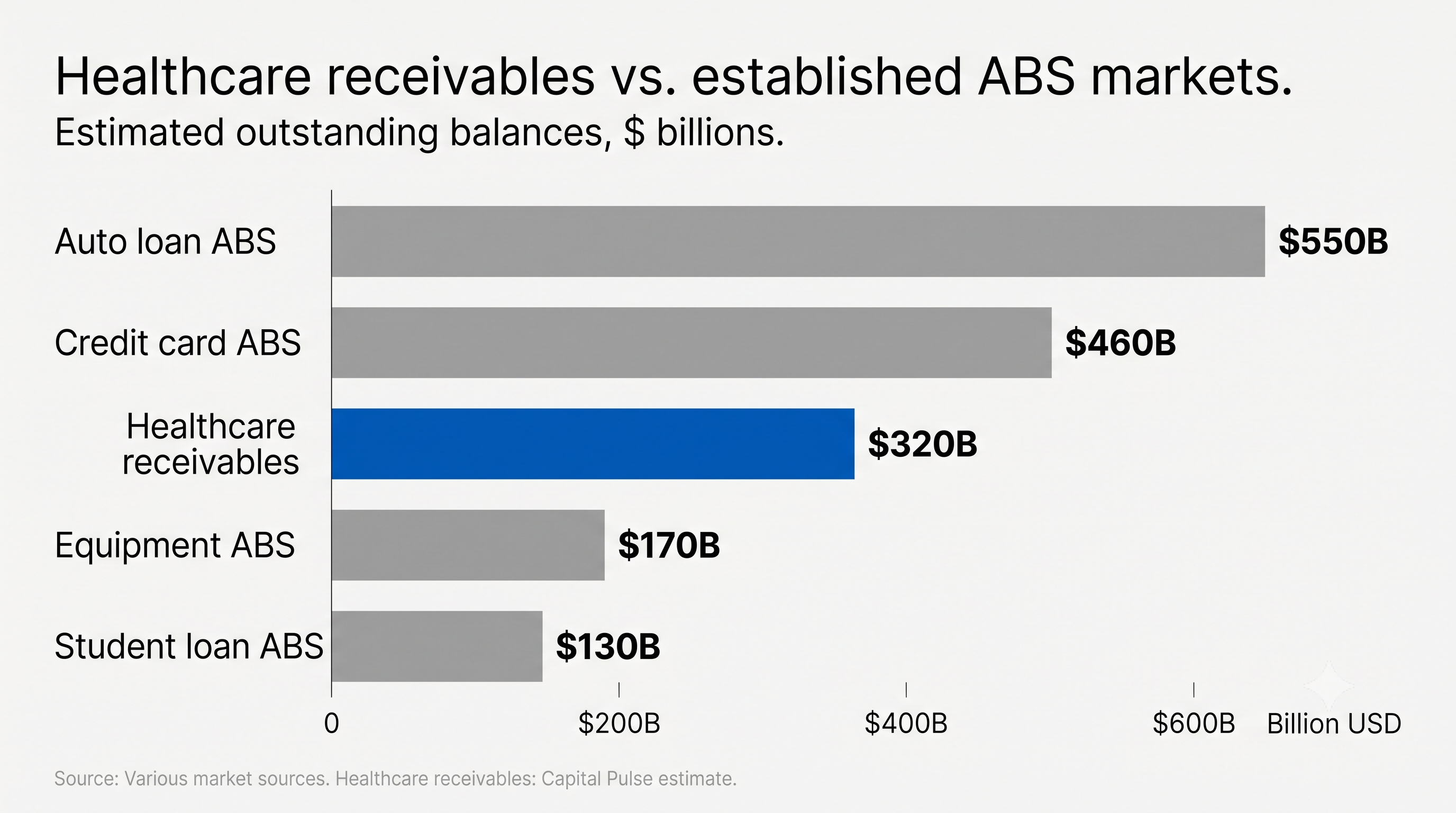
The U.S. medical payments market runs to roughly $2.6 trillion annually. Applying an industry-standard collection profile, the annual institutionally addressable flow is on the order of $2.2 to $2.4 trillion. At any given moment, the rolling, monetization-ready financing pipeline standing behind it exceeds $320 billion.
That last number is the one that matters, because it is the pool an allocator could actually access. It is not a projection or a total-addressable-market slide. It is the value of validated, adjudicated claims owed by creditworthy payers that exist, right now, on hospital balance sheets, waiting on payment timelines that no healthcare provider controls.
For scale: $320 billion of outstanding receivables places this squarely in the range of established consumer ABS sectors: the auto and card markets that institutional investors have underwritten comfortably for decades. The difference is that those markets have a mature standardization layer. Healthcare receivables, until recently, have not.
The Case for Non-Correlation: Look at the Obligation, Not the Sector
The diversification argument for this asset class is frequently made badly, so it is worth making carefully. A receivable is a claim on a specific payer. Its value depends on three questions: 1) will the payer pay the claim, 2) how much will they pay, and 3) when will they pay? It does not depend on healthcare equity valuations, hospital enterprise value, or investor sentiment toward the sector. When evaluating this asset, the relevant question is not "how does healthcare stock perform in a downturn" — it is "how durable is the payer's obligation through a downturn."
On that question, the evidence is unusually strong, and it rests on three structural buffers rather than on market history. Demand is non-discretionary. Healthcare consumption is among the most inelastic in the economy. Patients do not defer chronic disease management, emergency procedures, or life-sustaining medication because their portfolios are down. Unlike travel, retail, or automotive demand — all of which compress sharply in a contraction — the volume of care delivered is driven by illness, not by consumer confidence.
Chronic conditions anchor the spend. The CDC attributes the overwhelming majority of U.S. healthcare expenditure to the treatment of chronic conditions — diabetes, cardiovascular disease, and related comorbidities. These generate continuous, recurring, medically necessary spending loops that are structurally insensitive to market sentiment. This is not cyclical consumption; it is a demographic obligation.
Public payers expand counter-cyclically. More than 42% of national health spending flows through public insurance — principally Medicare and Medicaid. This is the most important and least appreciated feature of the asset class. In a downturn, as private commercial coverage contracts with employment, public safety-net enrollment expands. The payer mix shifts, but the payer obligation does not disappear. For a holder of receivables, the counterparty in a recession is increasingly the federal government.
The Standardization Layer: HCSS
Visibility is the reason this asset class has never been poolable at scale.
To a capital provider, an individual medical claim has historically been an opaque IOU: an obligation of uncertain timing, uncertain amount, and uncertain denial probability, originated by a provider whose own balance sheet may be thin. Two hospitals with nominally similar receivables could carry very different risk.
Previously, there was no common language for the quality of the paper.
Capital Pulse has built one. Our Healthcare Claims Scoring System (HCSS) applies AI and statistical learning to historical claims data to predict the outcomes that determine value — payment probability, payment timing, expected amount, and denial risk — and assigns a standardized score to the claims portfolio itself. Functionally, it is a FICO score for medical receivables.
The consequence is the thing that matters for capital markets. HCSS converts idiosyncratic, hospital-specific claims risk into a standardized, comparable, poolable metric. It shifts the underwriting question away from the originating hospital's balance sheet and onto the creditworthiness of the payer standing behind each claim — federal or state government, or a major commercial insurer. That is the risk institutional investors actually want to hold, and it is the risk they can now see. Standardization is what makes pooling possible. Pooling is what makes Medical Receivables-Backed Securities (MRBS) possible.
What the Structure Actually Is: The Asset, Not the Servicing
Capital Pulse does not originate loans against receivables. Our banking partners purchase them outright, in a true sale. Ownership of the claim transfers to the buyer.
What does not transfer — and this is the design decision that distinguishes the Capital Pulse method from a conventional receivables purchase — is the servicing. The provider's billing department continues to pursue reimbursement on every claim, exactly as it did before the sale. The bank buys the asset. It does not buy the collections operation.
This matters more than it may initially appear, because the alternative is worse in both directions. When a purchaser takes over servicing, it inherits a collections function it is structurally unsuited to run: it lacks the payer relationships, coding expertise, appeals history and institutional knowledge of the provider's own revenue cycle team. Collection performance degrades precisely when the new owner needs it most. Traditional medical factoring has always carried this defect, and it is one reason the paper has historically been priced so punitively.
Capital Pulse leaves collections with the people who are best at it, and then aligns their incentives to do it well. The billing department, as servicer, retains a direct, continuous, economic stake in maximizing collection on every claim it has already sold — which is precisely the behavior an investor wants from a servicer, and precisely the behavior that a conventional sale extinguishes.
The result is a structure in which each party holds what it is best equipped to hold. The hospital retains the collections function it already excels at, along with the upside on its own performance, and receives liquidity without adding debt, triggering covenants, or consuming borrowing capacity. The investor acquires a transparent, HCSS-scored claim on payer performance — serviced by the party with the deepest possible knowledge of the underlying paper and a live financial interest in its outcome.
This is what makes the asset class poolable at institutional scale. Servicing quality is the single largest source of variance in receivables performance, and this structure does not merely preserve it — it incentivizes it.
The Risks Worth Naming
An asset class is defined as much by the risks it carries as by the returns it offers, and the risks here are real, identifiable, and worth stating plainly.
Reimbursement-policy risk. A change in federal reimbursement rules can affect an entire pool simultaneously. This is the most genuinely correlated risk in the asset class, and it is not diversifiable within it. It is, however, observable, slow-moving, and subject to public rulemaking — which makes it a very different animal from market risk.
Payer concentration. A pool weighted toward a single commercial payer inherits that payer's idiosyncratic behavior. Pool construction, informed by HCSS scoring, is the control.
Origination and servicing risk. The quality of a receivable depends on the quality of the claim underneath it and on the discipline of the revenue cycle team pursuing it. Because servicing is retained by the provider, the investor's outcome is linked to that team's continued performance, which is why HCSS scores the portfolio at origination rather than assuming uniformity across providers. An investor in this asset class is underwriting the payer's obligation and the originator's collections competence, and both are measurable.
We raise these because sophisticated allocators will raise them, and because an asset class that cannot articulate its own risk factors is not yet an asset class.
A Defensive Asset With a Social Dividend
There is one further characteristic that distinguishes this paper from a comparably sized consumer ABS pool. When an investor buys a pool of medical receivables, the capital goes to fund hospital operations — payroll, supplies, staffing, capital equipment — at institutions that have already delivered the care and are simply waiting to be paid for it. The liquidity gap this closes is not an abstraction. It is the gap that often forces rural hospitals to defer hiring, safety-net providers to cut service lines, and health systems to hold defensive cash they could otherwise deploy into patient care.
Capital that shortens the distance between care delivered and care funded is capital doing something. For allocators operating under an impact or ESG mandate, this is a rare instance in which the diversification case and the social case are not in tension — they are the same case, viewed from two sides.
The Window
Asset classes do not stay inefficient forever. The excess return available in mortgages, in auto paper, in every market that made the journey from idiosyncratic to standardized, was largest in the years immediately after the standardization layer arrived and before capital fully priced it in.
That standardization layer for healthcare receivables now exists. The pool is over $320 billion and rolling. The demand behind it is demographic, non-discretionary, and creditworthy — backed by the government and high-credit commercial payers.
The question for institutional allocators is not whether this becomes an asset class. It is whether they are early to it.
Capital Pulse works with healthcare providers to score their receivables at scale. If your institution is evaluating this asset class, we're glad to walk through HCSS methodology, pool construction, and historical performance under NDA.