Joseph Riddle Joseph Riddle

10 Steps to Modernize Healthcare Finance in 2026: Building Stability Through Innovation

As we close out 2025 and look toward the year ahead, the healthcare finance industry stands at a critical juncture: facing extended payment cycles that routinely exceed 120 days, unpredictable payer behavior, and razor-thin operating margins.

But 2026 offers an opportunity for transformation. The technology to solve these problems exists. Here are ten critical steps the industry can take to modernize payment systems and create the financial stability healthcare desperately needs.

Read More
Joseph Riddle Joseph Riddle

Building a New Asset Class: The Infrastructure Requirements for Medical Receivables-Backed Securities

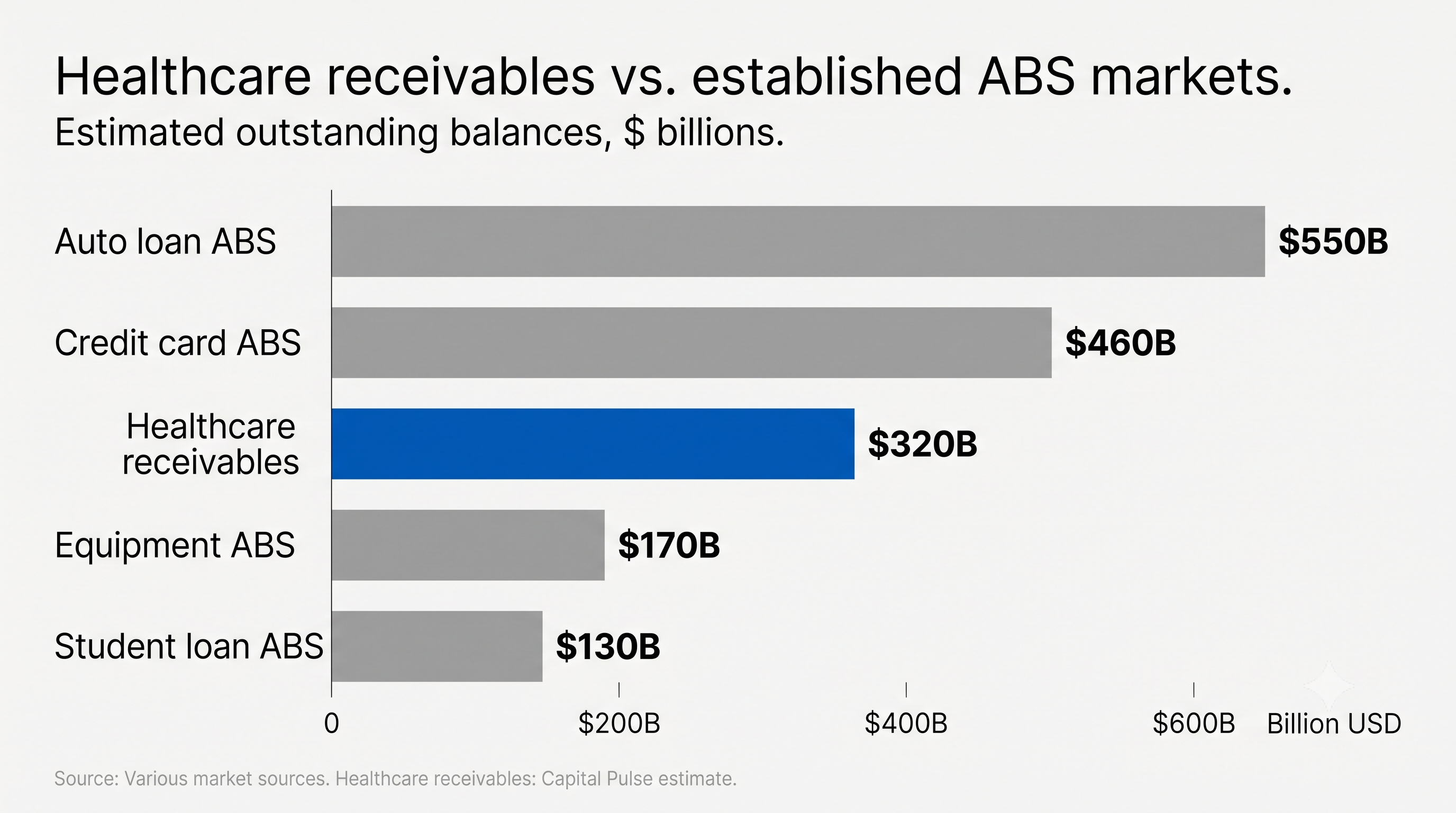
Hospitals that should qualify for prime lending rates pay premium costs simply because their assets can't be accurately valued using conventional methods. But what if medical receivables could be transformed into a predictable, bankable asset class? What if they could be standardized, scored, and securitized — much like mortgages were decades ago? The technology to make this possible exists today. What's needed now is the infrastructure to support it.

Read More
Joseph Riddle Joseph Riddle

The Cash on Hand Paradox: Why Hospitals Hoard Money — And How AI Can Change That

In most industries, sitting on a year's worth of operating expenses in cash would be concerning — the sign of a company too afraid to invest, facing uncertain customer demand or stagnant growth opportunities.

The healthcare industry's reliance on massive cash reserves reflects a fundamental dysfunction in how revenue flows through the system. It is a buffer not for shrinking demand, but rather for uncertain payments from insurers. AI-powered financial solutions are changing this.

Read More
Joseph Riddle Joseph Riddle

AI-Powered Healthcare Lending is the Next Frontier for Financial Institutions

Traditional lenders view medical receivables with skepticism, considering them questionable collateral due to uncertain value and unpredictable timing. Hospitals often lack insight into the true value of their debt, making it difficult to present an accurate financial picture. This opacity leads to less favorable borrowing terms — exactly when healthcare providers need support most. By embracing AI-powered valuation of medical receivables, lenders can unlock a robust new asset class and gain significant competitive advantage while strengthening the financial health and resilience of America's healthcare system.

Read More
Joseph Riddle Joseph Riddle

Beyond the Balance Sheet: How RCM Data Becomes Your Strategic Financial Forecast

Medical receivables are the amounts owed to a provider for services rendered — representing the organization's financial health. Revenue Cycle Management (RCM) systems handle the complex billing processes involved, including insurance claims, patient co-pays, and deductibles. While RCM is an effective operational tool, modern challenges demand that providers elevate this data into a strategic finance asset. The question is no longer simply "Are we processing claims efficiently?" but "What can our claims data tell us about our financial future?"

Read More
Joseph Riddle Joseph Riddle

How AI Simultaneously Drives Up Healthcare Reimbursement Rates and Lowers Lending Costs

The healthcare sector is one of America's largest economic segments, yet it is chronically underserved by traditional lending. This disconnect persists because traditional lenders cannot accurately assess the true value of healthcare receivables — leading to punitive interest rates that burden providers. Now, AI is revolutionizing this dynamic by delivering unprecedented accuracy in claims valuation: boosting reimbursement rates for providers while enabling prime-rate lending for financial institutions.

Read More
Joseph Riddle Joseph Riddle

How HIPAA-Compliant AI Empowers Hospitals in Financial Negotiations

Healthcare providers operate in a uniquely opaque financial environment. Unlike traditional businesses with predictable revenue cycles, hospitals face extended payment timelines, multiple payer sources with varying rates, and labyrinthine billing requirements. This complexity creates dangerous information asymmetries that leave providers financially vulnerable — but artificial intelligence offers a path forward, provided it meets one non-negotiable requirement: HIPAA compliance.

Read More
Joseph Riddle Joseph Riddle

Leveling the Playing Field: AI Tools Help Healthcare Providers Navigate Insurer Negotiations

Healthcare providers operate at a significant informational disadvantage when negotiating with insurance companies. While insurers deploy sophisticated data analytics teams and maintain comprehensive claims databases spanning millions of transactions, most healthcare providers enter contract negotiations with limited visibility into their own performance patterns — let alone insight into insurer behavior.

Read More
Joseph Riddle Joseph Riddle

High-Deductible Health Plans Are Changing Hospital Collections — and Creating a Cash Crunch

The American healthcare landscape has fundamentally shifted over the past decade, with high-deductible health plans (HDHPs) becoming the dominant insurance model. While these plans promise lower premiums for patients, they've created an unexpected consequence for healthcare providers: a dramatic increase in patient-side financial responsibility that's disrupting traditional revenue cycles and creating new cash flow challenges.

Read More
Joseph Riddle Joseph Riddle

How Dead Claims and Bad Debt Are Strangling Hospital Operations

Medical receivables, which represent the lifeblood of hospital financial health, can become "dead claims" and bad debt when they are repeatedly resubmitted and denied by payers. All healthcare providers, large and small, hold some bad debt because of these unpaid medical claims. Understanding this crisis requires looking beyond traditional business metrics to grasp how the unique complexities of healthcare finance can push even well-managed hospitals to the brink.

Read More
Joseph Riddle Joseph Riddle

The Hidden Price Tag: How Healthcare Regulations Impact Your Bottom Line

Healthcare providers stand at the intersection of medical excellence and regulatory compliance. While regulations like HIPAA, Stark Law, and the Anti-Kickback Statute protect patients and maintain system integrity, they impose substantial financial burdens that often go unacknowledged in policy discussions. This exploration reveals the true costs behind regulatory compliance and offers strategies for efficient management.

Read More
Joseph Riddle Joseph Riddle

Why Financial Services Should Take Another Look at Medicare and Medicaid Receivables

The healthcare sector represents one of the largest and most stable segments of the American economy, yet it remains chronically underserved by traditional lending institutions. For decades, financial services professionals have viewed Medicare and Medicaid receivables with skepticism — for good reason. But AI is fundamentally changing this landscape, creating an unprecedented opportunity.

Read More
Joseph Riddle Joseph Riddle

The Medicaid Waiting Game: Why Hospital Finances need an AI Revolution

A recent investigation by the Wall Street Journal (article paywall protected) has exposed a troubling reality: hospitals nationwide are laying off staff and halting payments to medical suppliers while waiting for millions in delayed Medicaid funding. This isn't just another healthcare finance story — it's a systemic crisis that calls for immediate attention and innovative solutions.

Read More
Joseph Riddle Joseph Riddle

Strategic Hospital KPIs: Measuring Financial Performance in Healthcare

In an era where the average hospital operating margin hovers around 2.5%, every financial decision becomes critical. Hospital leaders face unprecedented challenges: rising costs, declining reimbursements, and increasing regulatory demands. To navigate this complex landscape successfully, they need more than intuition — they need data-driven insights.

Read More
Joseph Riddle Joseph Riddle

Cyber Threats in Healthcare: The Case for AI-Powered Financial Resilience

Healthcare organizations have become prime targets for cyberattacks due to their valuable data, critical infrastructure, and often outdated security systems. As digital transformation accelerates in healthcare, the attack surface continues to expand, making cybersecurity a critical concern for hospitals and healthcare providers.

Read More
Joseph Riddle Joseph Riddle

Denials vs. Zero-Payment: A Critical Distinction in Healthcare Receivables

For financial services professionals evaluating healthcare investments, understanding medical receivables is essential. Among the most frequently misunderstood concepts are the crucial differences between claim denials and zero-payment adjustments. While both result in no payment to the provider, they represent fundamentally different scenarios with distinct implications for financial risk assessment.

Read More
Joseph Riddle Joseph Riddle

Decoding Medical Receivables: Helping Banks Understand Your Healthcare Debt

Healthcare financial professionals face a common frustration: traditional banking partners often struggle to understand the true value of medical receivables. Many healthcare organizations receive unfavorable lending terms simply because banks don't have the right tools to evaluate the unique nature of medical claims.

Read More
Joseph Riddle Joseph Riddle

Rethinking Risk Assessment: Why Banks Need a New Approach to Healthcare Lending

As the healthcare sector faces unprecedented challenges, traditional approaches to risk assessment in healthcare lending are becoming increasingly inadequate. The banking industry stands at a critical juncture: either adapt our evaluation methods to better serve this vital sector or risk missing out on significant opportunities while potentially contributing to a growing healthcare crisis.

Read More
Joseph Riddle Joseph Riddle

Beyond Cost-Cutting: Strategic Financial Planning for Healthcare Organizations

In today's challenging healthcare landscape, many organizations default to cost-cutting as their primary financial strategy. While controlling expenses is important, relying solely on cost reduction can lead to diminishing returns and potentially compromise the quality of care. Forward-thinking healthcare organizations are discovering that sustainable financial health requires a more comprehensive, strategic approach that goes beyond traditional cost-cutting measures.

Read More